This post contains affiliate links. I may earn a commission at no extra cost to you.
A piece of fruit, of all things
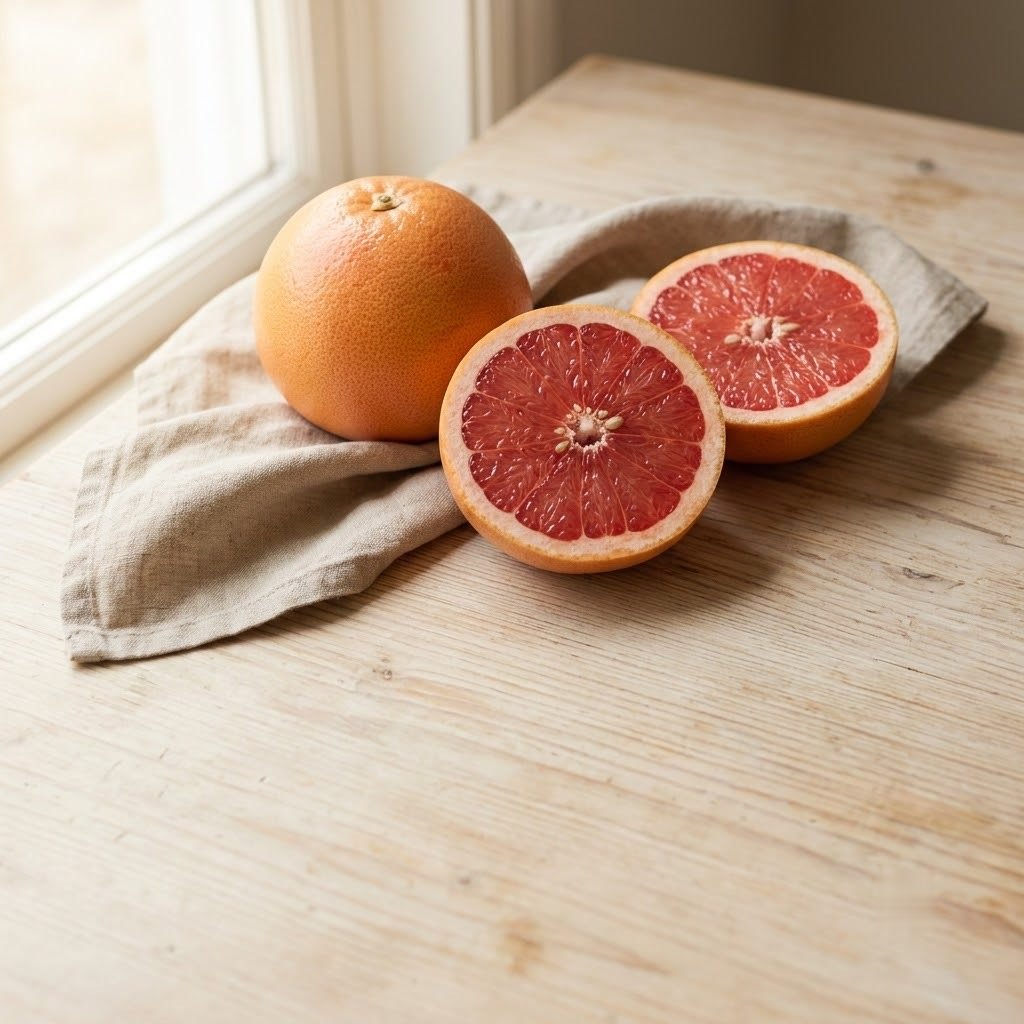
If you asked a room of people to name the most dangerous thing in an average kitchen, nobody would say the fruit bowl.
And yet grapefruit is one of the few foods that comes with a genuine, documented warning printed inside medication leaflets — the kind of leaflet most of us glance at once and then fold back into the box.
This is not a scare story about a superfood gone wrong. Grapefruit is a perfectly good fruit. The problem is narrow and specific, it affects a particular group of medicines, and once you know whether you are in that group you can stop thinking about it entirely.
That is the point of this page: to get you to a yes or a no, quickly.
What actually happens
Your body does not absorb a tablet whole. Before a medicine reaches the bloodstream, part of it is broken down — a lot of that work happens in the wall of the small intestine, using a family of enzymes.
Grapefruit contains compounds that switch one of those enzymes off.
With the enzyme out of action, less of the tablet gets broken down on the way in. More of it arrives in the blood than the dose was designed to deliver. You took one tablet. Your body behaves as though you took more than one.
How much more varies enormously — by the drug, by the person, by how much grapefruit. That variability is exactly why the advice tends to be “avoid” rather than “have a little”. Nobody can tell you in advance which end of the range you personally sit at.
There is a second, rarer effect that works the other way round: with a small number of medicines, grapefruit reduces absorption instead, so less of the drug gets in than intended. Same conclusion — it changes the dose you actually receive.
Which medicines are affected
The honest answer is that the list is long, it spans several unrelated conditions, and it changes as new medicines come to market. This is why no article — including this one — should be your final word on it.
Groups that commonly appear on the list include:
- Some cholesterol tablets. Not all statins. Several are affected significantly; others barely at all. Which one you are on matters.
- Some blood pressure tablets, particularly certain calcium channel blockers.
- Some heart rhythm medicines.
- Certain anti-anxiety and sedative medicines.
- Immunosuppressants, including those taken after a transplant — where the consequences of an unintended dose change are serious.
- Some medicines for an enlarged prostate, and several others across unrelated categories.
Notice what those have in common: they are all medicines people take every day, for years, often starting in their fifties and sixties. That is precisely the group most likely to have a grapefruit habit at breakfast.
The part that catches people out
A reasonable person, told that grapefruit and a tablet interact, does the obvious thing: takes the tablet in the morning and eats the grapefruit at night.
It does not work.
The enzyme is not blocked for an hour or two. Once grapefruit has switched it off, the body has to manufacture new enzyme to recover — and that takes far longer than the fruit takes to leave your system. A glass of juice with breakfast can still be affecting a tablet taken much later in the day.
So this is not a timing problem that spacing solves. It is a yes-or-no question.
Two more details worth knowing:
- Juice counts. Often more than the fruit, because juice is concentrated and people drink more of it than they would eat.
- It is not only grapefruit. Seville oranges — the bitter kind used in marmalade — and pomelo belong to the same family and can behave the same way. An ordinary sweet orange does not.
What to eat instead
This is the good news, and it is why the warning is less painful than it sounds.

An ordinary orange does not block the enzyme. Neither does an apple, a pear, berries, or a banana. Nobody is being asked to give up fruit at breakfast — only to swap one specific fruit for almost any other one.
If grapefruit is on your list, put an orange in its place and the problem is over. That is the entire fix.
And if you were eating grapefruit because you believed it helped with weight or with blood pressure specifically — the foods that actually do that work are ones you can eat freely alongside any medication.
The one question to ask
Take your medication list — the actual list, not from memory — to the pharmacy counter and ask:
“Is grapefruit a problem with anything on this list?”
That is it. No appointment. No charge. Your pharmacist can check every item in about a minute, and the answer is specific to you rather than to a general article.
Ask it again whenever a new medicine is added, because the answer can change with one new prescription. While you are there, it is worth asking the same question about anything else you take — several common medicines quietly affect how you absorb B12, and nobody mentions that either.
Who needs to act on this
This is for you if
- You take any daily medication and eat grapefruit or drink grapefruit juice
- You take a statin, a blood pressure tablet or a heart rhythm medicine
- You take an immunosuppressant after a transplant — this group matters most of all
- You have just been prescribed something new and used to eat grapefruit
Skip this if
- You take no regular medication — grapefruit is simply a fruit, enjoy it
- You have already checked your specific list with your pharmacist and been told it is fine
The short version
Grapefruit is not dangerous. Grapefruit with certain medicines is.
You cannot work out which group you are in from a list on the internet, because the answer depends on the exact medicines you take. But you can settle it permanently with one question at a counter you already visit.
Until you have asked, the safe move is simple: an ordinary orange does the same job at breakfast.
One short email a week. Plain English, no miracle cures, and the occasional thing like this one that is genuinely worth knowing before you find out the hard way.
Medical disclaimer. This site does not provide medical advice. Information here is for general education only. Consult your doctor or pharmacist before starting any supplement, especially if you take prescription medicine.